
Should we build local businesses that can finance a downtown revitalization or restore buildings to attract outside companies to move in? As an architect, this may be a surprising answer. Being integrally tied to the construction industry, our profession must develop a deep understanding of boom and bust economic cycles, and in particular recognize that real estate and construction is a support sector of the economy, not an economy unto itself.
It is clear that over the long term, our currently emerging strategy is flawed in that it will perpetuate the outflow of capital from the CSRA. Businesses, for all their flaws, build what they need. Governments build what they think businesses need. If we want to create a sustainable vibrant local economy, we must focus our efforts on supporting local startup businesses that will hire local people and return profits to the local economy. Governments can encourage this development through tax incentives for local investment and grants to support small businesses and research.
If we do this, we will create a lasting prosperity to sustain the long term revitalization of our area and mitigate the extreme cyclical nature of the real estate and construction industries.
Tuesday, May 14, 2013


Tuesday, January 22, 2013
Innovation Architect
How do you start a post that is intended to be a summary explanation of a philosophical transformation of your approach to work? Undoubtedly anything you write will seem pompous, and even more so you are sure to be longwinded and a potential bore to your readers. So in short, I think most of what we celebrate in the architectural world is bullshit. We celebrate the ability to spend money, and we celebrate it so much so that people spend inordinate amounts on projects they inherently know are temporary.
What makes this absurd is the push over the last decade to celebrate the 'industrial' look. It absolutely pains me to explain to clients that in order to achieve an effective 'warehouse' aesthetic they will need to spend 3 times the amount of money to use rigid spiral ducting so they don't see cheap flex ducts. That instead of just running power and cabling from point a to b, they need to install cable trays and conduit to give it a more orderly appearance. Imagine a client's lack of enthusiasm when told how many thousands they need to spend to spray encapsulate fireproofing so that it doesn't flake off on their desktops over time and can then be painted so that it doesn't look like hideous spray on fireproofing anymore. That industrial stainless look in a kitchen or breakroom...absolutely the most expensive way to go, and most if it isn't even industrial grade. Want to save money and have cubicles in an open office, that's great, but cubicles cost 3-5 times more than a desk. We're talking about millions of dollars wasted here, all because people are sold on a style and the false impression that its cheaper.
The simple fact is that you can have a kick ass space and not spend a fortune on it, but you have to accept that raw means just that. $15 can buy all the materials you need for an awesome desk made of dimensional lumber and exposed bolt heads. It's up to you to find someone who will assemble it with thought and care.
Thursday, December 6, 2012
Building Dreams
As many of you know, the last two years of my life has been spent pursuing a dream of revitalizing downtown Augusta through the creation of a very broadly encompassing coworking space, inventor’s workshop, education center, and think tank. I have met many talented and generous people in Augusta along the way. Together with the help of a great many contributors from our community, we are making that dream a reality at theClubhou.se
What is the theClubhou.se Member Value Proposition?
Let’s face it, your achievements in life are the product of your talent or skill, your willingness to work, and the people you know. theClubhou.se provides education and fellowship meant to improve yourself. theClubhou.se provides space and equipment to use so that you can work more efficiently and on things that would be difficult to do otherwise. theClubhou.se is full of people who want to know you and help you succeed.
For adults and professionals, $100 per month gains you full membership in theClubhou.se. Become a student of something new, help others learn from your expertise, collaborate and change the world!
If you would like a dedicated space at theClubhou.se just email us at heythere@theClubhou.se
College and High School Students, Seniors, and Veterans can join for $50/month with free day use access, as well as classes, and member events.
How theClubhou.se can help your local community?
Starting with our 15th member, every 5 members we get, we can fund Smartkids.sc to deploy one lighthouse beacon from Hack for Education. That neighborhood will be chosen by the new members who are responsible for that beacon.
This will allow us to self fund our project and promote goodwill in the community. The people on this email list are the first 12 members. We need 3 more and we can do this.
This will also mean that after the initial beacon is installed, each additional beacon will allow both us and our partnering non-profit SmartKids.sc to support another neighborhood, as well as provide an $400 additional per month to fund operations and promising member projects at theClubhou.se.
At theClubhou.se, we don't invest in companies, we invest in the future of our community.
Looking forward to seeing you and your friends at our first /openhouse this December 7th during First Friday at theClubhou.se on 816 Broad St., Augusta, GA, by the Common. Until then, visit online at theClubhou.se

Monday, August 27, 2012
Architecture, why bother?
I often wonder if ancient times had any architects that were not temple builders. We live in a world where virtually nothing is built for the ages, and yet we build so much. We have architects with all types of specialties; residential, commercial, retail, laboratories, stadiums, hotels, hospitals, prisons, schools, interiors, landscapes, urban planning, factories, government, and of course religious buildings. I've personally worked in 11 of those types, though the vast majority of my work has been divided between commercial offices, interiors, and laboratories.
Perhaps it is due to a lack of understanding about ancient society, but I find it hard to believe that there were more than a small handful of architects in Rome at any given time. According to Roman census figures there were approximately 5 million citizens within the empire in first century B.C. If we generously say the were 20 architects, that would have meant one architect for every 250,000 people.
In contrast, I entered architecture school at Georgia Tech with over 100 other young students. Even with attrition, we graduated over 30 new architects from one school in one year. There are currently 154 accredited Architecture programs in the United States. We have roughly 105,000 architects in a country with just under 315,000,000 residents; giving us a ratio of one architect for every 3,000 people. Once minors (20% ~600), unemployed and underemployed (15% ~450), and retirees (12% ~ 360) are removed, that leaves one architect for every 1590 employed adults in America.
These statistics present the obvious dilemma that leave so many architects feeling disgruntled and frustrated. I however choose to look at what opportunities this creates for society. Architects receive a unique education that involves creative technical problem solving, subjective arts and humanities, geometry, history, physics, and philosophy. We are roughly equal parts artist, engineer, and lawyer. We must be proficient in each to succeed, and our career is determined by which one of these roles we gravitate most strongly towards.
This lack of specialization is the fundamental strength of architectural education and allows Architects many options for how best to contribute to society. Among my architect friends I know graphic, web, and video game designers, politicians, inventors, writers, salesmen, public policy advocates, furniture designers, attorneys, construction managers, chefs, professors, and traditional architects. I have lived primarily as an architect and entrepreneur, but mostly I thrive on the enjoyment of the creative process itself. The moment inspiration sparks is a thing of beauty, hope, and joy. Whether you're designing a building, a company, or an urban plan, good design has a way of taking on a life of its own. The proper framework allows the process to become organic and the end product to become self defining. Truly great work challenges you to match wits with it in order to not limit the potential of the design.
Truly great work makes you better...
Perhaps it is due to a lack of understanding about ancient society, but I find it hard to believe that there were more than a small handful of architects in Rome at any given time. According to Roman census figures there were approximately 5 million citizens within the empire in first century B.C. If we generously say the were 20 architects, that would have meant one architect for every 250,000 people.
In contrast, I entered architecture school at Georgia Tech with over 100 other young students. Even with attrition, we graduated over 30 new architects from one school in one year. There are currently 154 accredited Architecture programs in the United States. We have roughly 105,000 architects in a country with just under 315,000,000 residents; giving us a ratio of one architect for every 3,000 people. Once minors (20% ~600), unemployed and underemployed (15% ~450), and retirees (12% ~ 360) are removed, that leaves one architect for every 1590 employed adults in America.
These statistics present the obvious dilemma that leave so many architects feeling disgruntled and frustrated. I however choose to look at what opportunities this creates for society. Architects receive a unique education that involves creative technical problem solving, subjective arts and humanities, geometry, history, physics, and philosophy. We are roughly equal parts artist, engineer, and lawyer. We must be proficient in each to succeed, and our career is determined by which one of these roles we gravitate most strongly towards.
This lack of specialization is the fundamental strength of architectural education and allows Architects many options for how best to contribute to society. Among my architect friends I know graphic, web, and video game designers, politicians, inventors, writers, salesmen, public policy advocates, furniture designers, attorneys, construction managers, chefs, professors, and traditional architects. I have lived primarily as an architect and entrepreneur, but mostly I thrive on the enjoyment of the creative process itself. The moment inspiration sparks is a thing of beauty, hope, and joy. Whether you're designing a building, a company, or an urban plan, good design has a way of taking on a life of its own. The proper framework allows the process to become organic and the end product to become self defining. Truly great work challenges you to match wits with it in order to not limit the potential of the design.
Truly great work makes you better...
Thursday, August 23, 2012
the Stories of Buildings
Architecture is storytelling to the soul. I help people and organizations understand, translate, and narrate those stories to the world. For me, each story is a chapter in a great book that is both read and written together.
I've always been a bit puzzled by the ego of many architects. The belief for many seems to be that buildings are an expression of the architect's personal philosophy and attitudes towards the world. The problem with this approach is that buildings and architecture, when at their best, become an embodiment of the ideals of those who inhabit and use them.
Our philosophy of architecture has always been to help unleash the creativity of the end user through the development of an intimate understanding of their difficulties, desires, and ambitions. We take this approach of empathy towards the users so that a building not only provides usable space, but becomes a usable, functional expression of the client and end users needs and aspirations.
In many ways, we believe the architect's role is to facilitate the creative process for the client. This does not mean however that the we become a drafting and permitting service for them. It is our responsibility to respectfully challenge their existing notions to find unexpected and innovative solutions.
Ultimately, these things are critical for companies. A building or space is a highly visible component of a company brand that impacts both external and internal perceptions of a business. The care and thought behind every decision becomes obvious after several thousand cumulative man-hours in a space. The building quite literally portrays an identity, it is a realization of identity through the built form. Your hopes, your needs, your story.
These stories become our journey to understand and help shape attitudes about the world we share.
I've always been a bit puzzled by the ego of many architects. The belief for many seems to be that buildings are an expression of the architect's personal philosophy and attitudes towards the world. The problem with this approach is that buildings and architecture, when at their best, become an embodiment of the ideals of those who inhabit and use them.
Our philosophy of architecture has always been to help unleash the creativity of the end user through the development of an intimate understanding of their difficulties, desires, and ambitions. We take this approach of empathy towards the users so that a building not only provides usable space, but becomes a usable, functional expression of the client and end users needs and aspirations.
In many ways, we believe the architect's role is to facilitate the creative process for the client. This does not mean however that the we become a drafting and permitting service for them. It is our responsibility to respectfully challenge their existing notions to find unexpected and innovative solutions.
Ultimately, these things are critical for companies. A building or space is a highly visible component of a company brand that impacts both external and internal perceptions of a business. The care and thought behind every decision becomes obvious after several thousand cumulative man-hours in a space. The building quite literally portrays an identity, it is a realization of identity through the built form. Your hopes, your needs, your story.
These stories become our journey to understand and help shape attitudes about the world we share.
Wednesday, August 22, 2012
Renaissance Mill
For an architect, Nikola Tesla has had an unexpected and amazing impact on my work. It began at the start of my career when I was asked to learn about and be inspired by the work of several notable scientists in the field of electricity before designing the Headquarters for the Electric Power Research Institute. Through my study, I was not just inspired by the ingenuity of Tesla, but also by the idealism that drove his pursuit. One quote in particular has always resonated deeply with me:
“War cannot be avoided until the physical cause for its recurrence is removed and this, in the last analysis, is the vast extent of the planet on which we live. Only through annihilation of distance in every respect, as the conveyance of intelligence, transport of passengers and supplies and transmission of energy will conditions be brought about some day, insuring permanency of friendly relations. What we now want is closer contact and better understanding between individuals and communities all over the earth, and the elimination of egoism and pride which is always prone to plunge the world into primeval barbarism and strife... Peace can only come as a natural consequence of universal enlightenment...”
Nikola Tesla, 1919
Following this, I attempted to use alternating current itself to create a metaphorical architectural language for EPRI to both show their dynamism and aspirations to the outside world, but internally to help facilitate a corporate culture that has become more open and collaborative.
Most recently I have been revisiting the ideas of Tesla to help create a revitalization effort in my hometown of Augusta, GA by converting the abandoned Confederate Powder Works building into a new cultural and economic center for the city. The mill is designed not only to harness the renewable power of the Augusta Canal, but also serve as a research and technology incubation facility, and public design studio and workshop where people can come, study, learn, collaborate and work together to manufacture a better future.
While the mill itself may seem a large and potentially daunting project, we have found significant support from our community from the grassroots to the institutional and government levels. We continue to take positive incremental steps forward together as a community and are finding that their is in fact a strong culture of innovation and collaboration that is present and can be nurtured.
I am thankful for Tesla. He has been a wonderful guide towards making the world a better place.

(proposed Renaissance Mill, copyright CONima, inc., ALL RIGHTS RESERVED)
Tuesday, August 21, 2012
Why Innovate?
Innovation is the result of curiosity, knowledge, and understanding. Can we figure out how to do something new, or better than it was done before? Can we continue to grow and become better as we move forward? If innovation is not pursued then we must admit that we are no longer progressing, that our best days have already been seen.
I've always been bothered by the phrase, "Don't reinvent the wheel." Is the wheel really that perfect? Over time it's continually been improved. Spokes and tires have been added to improve performance and durability. However, a wheel still only follows one vector on its own so steering wheels have been attached to allow turning. Should we abandon wheels altogether? A sphere could turn in any direction if we could just figure out how to balance a load on it while controlling its movement. Wheels themselves serve merely to hold us to the ground when perhaps we should fly.
Everyday we make the future. Why not make it better?
I've always been bothered by the phrase, "Don't reinvent the wheel." Is the wheel really that perfect? Over time it's continually been improved. Spokes and tires have been added to improve performance and durability. However, a wheel still only follows one vector on its own so steering wheels have been attached to allow turning. Should we abandon wheels altogether? A sphere could turn in any direction if we could just figure out how to balance a load on it while controlling its movement. Wheels themselves serve merely to hold us to the ground when perhaps we should fly.
Everyday we make the future. Why not make it better?
Sunday, January 8, 2012
McDonald's France
Interesting, but nothing feels relevant to McD brand...RT @designmilk: McDonalds restaurants in France get McFancy: j.mp/yhjx3l
— Eric Parker (@EP_AIA) January 8, 2012
Thursday, July 28, 2011
CONima Architects' latest project is in Bloomberg Businessweek
Our recent design for Innovation Endeavor's new Palo Alto office space was featured in Bloomberg Businessweek's article on the unconventional Venture Capital Firm funded by Google's executive chairman and former chief executive officer Eric Schmidt

The space was designed to be a continually evolving collaboration space that could be reconfigured in minutes for any situation. Every detail was done so that those in the space could see connection details and structural support for everything from the building structure, to the furniture, and that virtually every surface was a potential collaboration point; using such details as plexiglass walls which allow dry erase markers, and simultaneously make the interior wall structure visible.

Wednesday, July 27, 2011
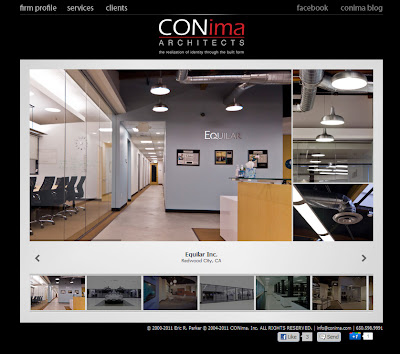
conima.com is LIVE!
After several partial redesigns, we finally redid our website. Please take a look at http://conima.com and see some of our more recent projects. We will also be adding additional updates in the coming weeks, but just couldn't wait to show off a little anymore! Also, PLEASE, PLEASE, PLEASE...show your support and hit the facebook 'like' and '+1' to help spread the word.

Sunday, July 24, 2011
Serious Energy select CONima Architects
CONima was recently selected for strategic planning, site acquisition, design, and project management services throughout North America.
We are proud to make our contribution towards green technologies and sustainable construction methods as part of the Serious Energy team.
Wednesday, March 9, 2011
Constructivism's reflection in the post millenium world
In design, inspiration is pulled from many places. A place you've been, a time in your life, a simple story. Lately, I've been feeling inspired by the contrasting geometry in Russian Constructivism. Below are a few images.
First is the cover of a book on construvist architecture from the British Library that focuses on the comparitive contrasts of the organic and mechanical using a human hand and compass. The overlay of the text is often important to emphasize the underlying geometry of the composition.

The next image is a propaganda poster by El Lissitzky entitled "Beat the Whites with the Red Wedge"
Also, see it's influence in an album cover from Franz Ferdinand.

First is the cover of a book on construvist architecture from the British Library that focuses on the comparitive contrasts of the organic and mechanical using a human hand and compass. The overlay of the text is often important to emphasize the underlying geometry of the composition.

The next image is a propaganda poster by El Lissitzky entitled "Beat the Whites with the Red Wedge"

Also, see it's influence in an album cover from Franz Ferdinand.

Subscribe to:
Posts (Atom)


 Posts
Posts


